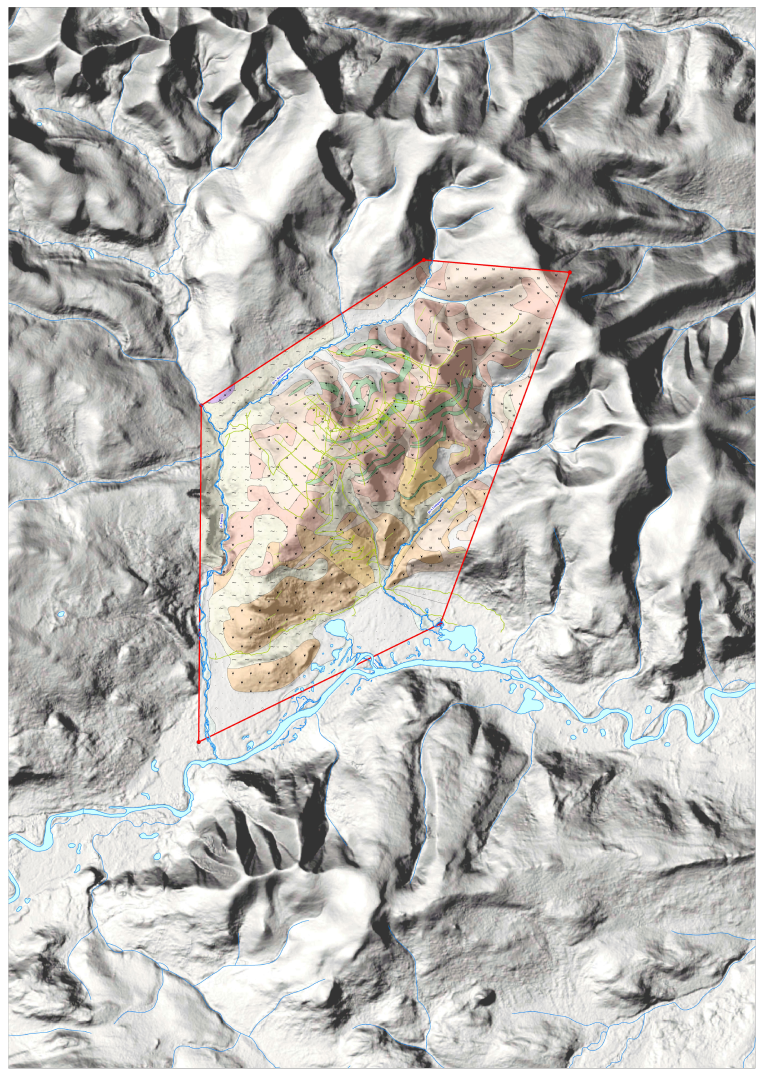
The stratified series of the Synnyr massif in the area of the licensed block consists of rhythmic layering of alkaline gabbroids, as well as melanocratic syenites (at the base) associated with them, and leucocratic feldspathoid (nepheline, nepheline-calsilite or calsilite) syenites in the upper part. The rocks of the stratified series (in the study area and beyond in the northeastern part of the Synnyr massif) have a low-angle bedding of both feldspathoid syenites and alkaline gabbroids. The full dip of the rocks do not exceed 10-15 degrees (west, northwest), and only in the center of the subsurface site Kalumnoe a northwest dip with angles up to 30-35 degrees is observed.
The formation of the intrusive complex took place in the conjunction zone of two regional diagonal fault structures of the north-eastern and north-western strike. The formation of these structures began in the Proterozoic; along them there are still tectonic activities. As a result, there is a dense network of multidirectional disturbances, which are accompanied by crushing zones, slickensides, metasomatic occurrences of a different nature and scale. A fault set forms a series of small blocks on the study area, and the eastern part and the central part of the productive zone, where the rocks of the stratified series have maximum angles of incidence to the northwest, are characterized by maximum fragmentation. On the eastern flank, the fall of the rocks becomes more gentle, tends to zero, and the size of the blocks is noticeably enlarged.
Kalsilite, nepheline-calsilite syenites (synnyrites) can be subdivided by structural and textural features into pseudoleucite with the presence of various symplektitic intergrowths of potassium feldspar and feldspatoids (from thin dactylotypic to micrographic) and granular varieties. In the section of the stratified series of the deposit, the rocks composed of symplektitic intergrowths predominantly occupy the upper parts, while the granular ones are the basis of deeper horizons. At the same time, pseudoleucite rocks contain minimal amounts of dark-colored and accessory minerals, while in granular rocks the role of biotite and clinopyroxene increases significantly, and apatite concentrations increase noticeably.
The bodies of melanocratic rocks intergrading with feldspathoidal syenites are zonal: in the central parts there are the most melanocratic rocks, up to biotized pyroxenites, in the marginal parts there are alkaline syenites with predominant microcline. Some changes in the material composition of these rocks with depth are observed – at hypsometrically low levels, amphibole and garnet containing varieties appear, sometimes with a high content of nepheline (more often its alteration products – zeolites).
Compositions of rock-forming minerals:
Feldspathoid syenites of the Kalyumny site are characterized by low variability in both mineral composition and major rock-forming oxides. Feldspars are represented by practically pure microclines, nepheline contains 27-28% of kalsilite minal. In alkaline gabbroids and associated mesocratic syenites, potassium feldspar contains up to 20% albite component. The compositions of the main dark-colored minerals in feldspathoidal syenites and alkaline gabbroids are practically identical and are represented by biotites and pyroxenes of the diopside-hedenbergite series.
Feldspar and feldspar-zeolite metasomatites form linear rims around zones of intensive tectonic disintegration, and in the areas of their intersection form fields with indistinct boundaries. Intensive microclinization in the immediate vicinity of tectonic structures is replaced by a focal process of complete or partial replacement of nepheline at a considerable distance.
Microcline-sericite metasomatites form vast fields, gravitating to the upper spinal parts of both the Kalyumnoe site and the Synnyr massif as a whole. They are distinguished by a stable mineral composition, which very weakly depends on the substrate composition.